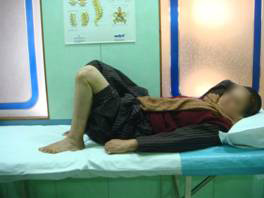

Intra articular fractures of Proximal Tibia
They are best treated with Ilizarov. The application of transosseous osteosynthesis by the ilizarov method of intra-articular fractures is indicated in a limited no. of circumstances as it is difficult to obtain anatomical reductions, Indications for treatment with this method are limited to open fractures and those in which there is compromise of the skin and surrounding soft tissues.
The preservation of active joint motion during the course of treatment coupled with minimal devascularization of the bony fragments with percutaneous fixation, may allow better remodeling of the joint surfaces.
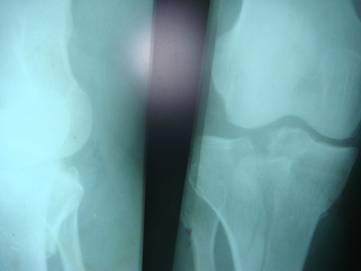
Tibial Plateau Fractures
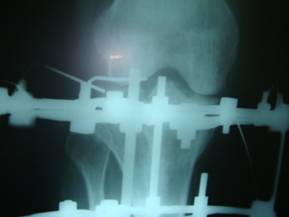
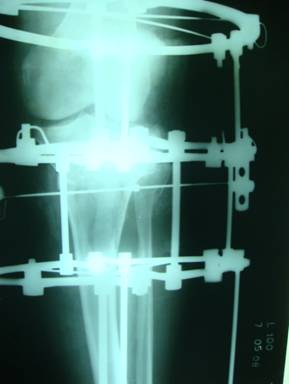
T and Y fractures of the tibial plateau(uni or bi condylar fractures) may also be reduced using olive wires placed in opposite directions and affixed to a ring.In some cases tto enhance stability the proximal ring may be extended to distal femur with a hinge across the knee joint and with a third ring to the distal tibia.Additional stabiliuty may be obtained using a distal metaphyseal ring with two plain wires.
Fracture Dislocation of the Ankle
It is important through preoperative planning to select the location of transosseous wires with or without olives in order to exert maximum interfragmentary compression.The apparatus must be extended to the middle third of the tibia proximally and occasionally to the hind foot or forefoot..This is particularly important if ankle arthrodesis is to be achieved.A complete ring may be used at the level of the distal tibia, if greater fixation is required.
Fractures of the Tibial Plafond
We feel that the ilizarov method may be particularly useful for severely comminuted tibial plafond fractures.The ability to maintain joint motions during treatment may contribute to improved results.The ilizarov method avoids the devitalization of smaller fragments by allowing preservation of their periosteal attachments.
The apparatus assembly utilizes three rings as for all fractures of the distal third of the tibia.The proximal ring is located in the middle third of the tibia provides the stability.Distally, two superimposed rings may be used and joined together with short threaded rods.At the most distal level, it is preferable to use a full ring in order to avail more holes for multiple inter-fragmentary wires and for extension of the assembly of the foot.
Associated malleolar fractures are reduced by olive wires connected to the appropriate rings.
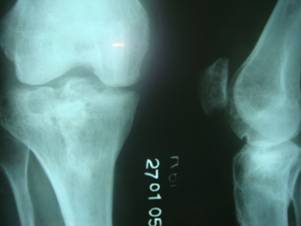
Before treatment
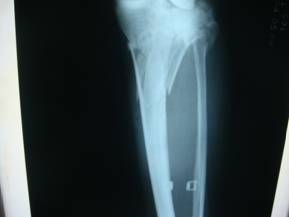
With fixator during treatment
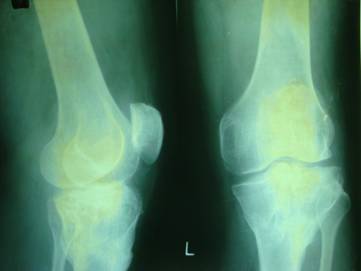
After treatment
Clinical Results