
Joint Contractures
Indications
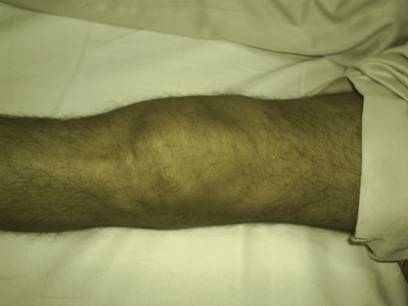
Chronic stiffness in joints may result from congenital malformations (web-syndrome failure of differentiation, coalitions-failure of separation or lack of motor power-anthrogyposis, spinal bifidia), acquired deformities(burns, septic arthritis, dislocations or intra articular fractures) or even iatrogenic cases (multiple surgeries, foreign bodies,infections).Contracture of the peri-articular soft tissue may or may not be superimposed upon actual intra-articular damage or fusion.
Arthrodiastasis or distraction of joint must transfer force to the soft tissues from the bone. Ligaments,tendons and capsular structures are primarily composed of collagen,which should respond to controlled distraction in a predictable manner based upon the biology of the distraction osteogenesis.Contracture of muscle though in part related to collagen,involves myofibrillar structures with active and passive elastically.Distraction of muscle is less predictable and often painful.
Technique
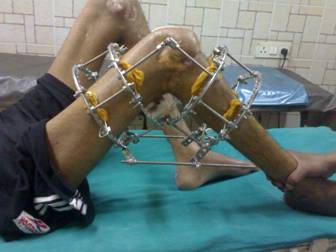
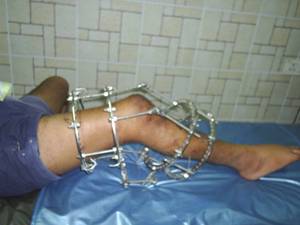
Gradual distraction of peri-articular soft tissues by the unique three-dimensional mechanical control of the ilizarov ring fixator follows certain principles of angular distractions such as the rule of triangles.Since a daily rate of one millimetre distraction of the soft tissue is most biocompatible, most joints permit one to three degrees of correction per day.
Although the knee and ankle are most commonly treated by arthrodiastasis, the elbow and , more rarely the wrist can also be addressed.As in deformity corrections , the threaded rod must constantly be self adjusting as the rings change their angulation.Fixation by twisted plates and mobile posts allow for spontaneous correction.In deformties exceeding 90 degree , the concave rod usually spans the outermost rings.Ring fixation is generally perpendicular to the diaphyseal axis of each segment.
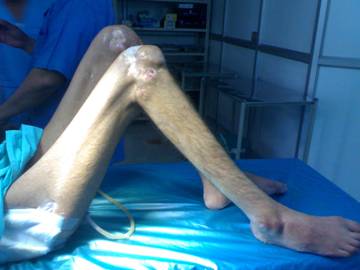
Before treatment
With Fixator during treatment
After treatment